DoublesMatch3Web
A complete guide to running pickleball, badminton and tennis doubles court rotations — player pool management, fair-play allocation, live court tracking, and session history.
 📸
1. Overview
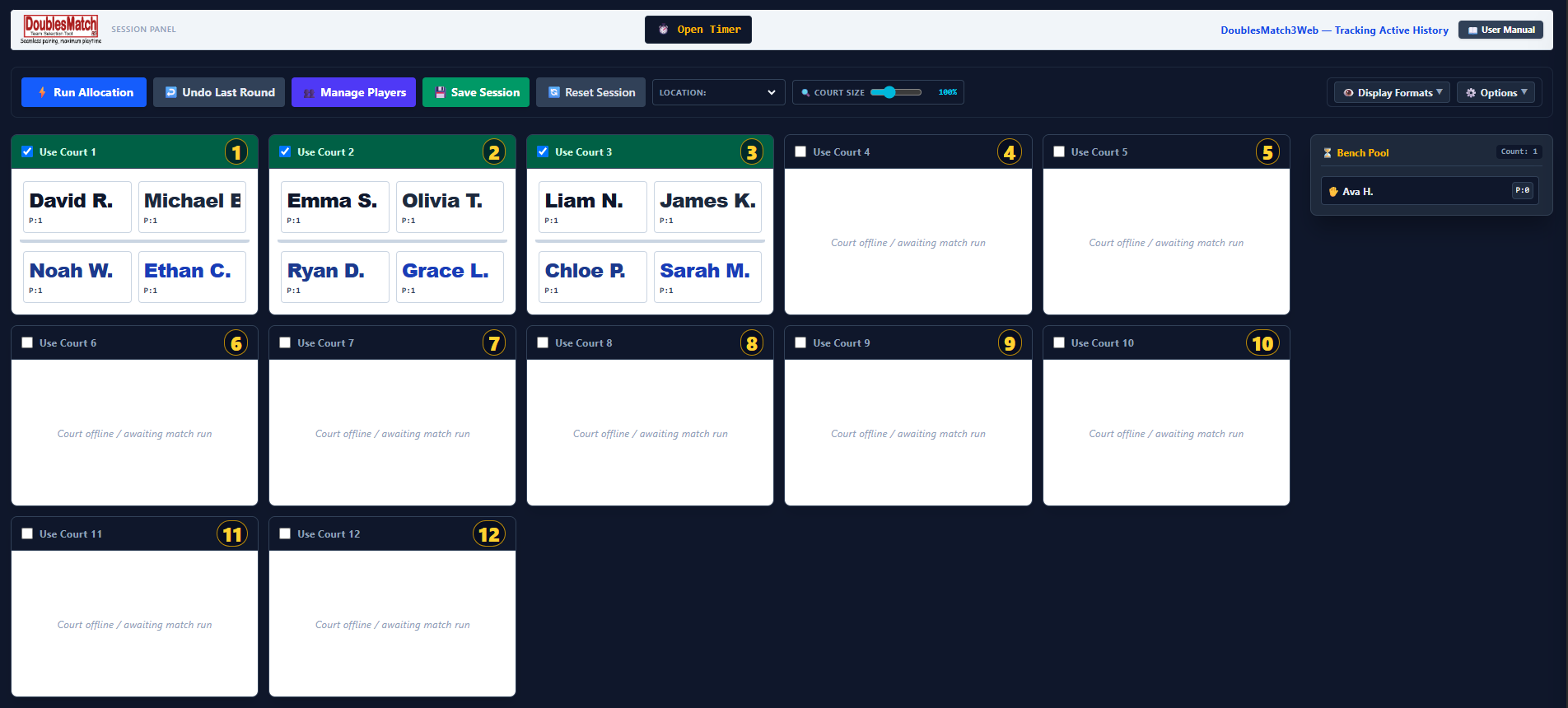
DoublesMatch3Web (DM3W) helps you run a doubles session — badminton, tennis or pickleball — for any number of players and courts. It keeps a pool of players, automatically allocates fair doubles matchups onto active courts each round, tracks who has played with whom and how often, and lets you manually override anything the automatic engine produces.
A typical session looks like this:
- 1Build or import your player pool, and mark everyone who is present as checked in.
- 2Choose your allocation options (fixed partners, mixed/gender/skill-tier doubles, rating balance, etc).
- 3Click ⚡ Run Allocation to generate the first round.
- 4Play the round, using the round timer in the Bench Pool sidebar if you like — click ⤴ Pop Out if you want it in its own window on a second screen.
- 5Click ⚡ Run Allocation again for the next round — the engine automatically prioritises anyone who sat out.
- 6At the end of the session, use 💾 Save Session to download your roster and the session summary.
2. Getting Started & Locations
The Location dropdown in the toolbar lets you keep separate player pools and rounds for different venues (for example, two different clubs or courts on different nights) inside the same installation of the app.
 📸
Changing location
Selecting a different location from the dropdown will:
- Ask you to confirm, since it resets the current round board.
- Optionally offer to download the current roster and the session summary before continuing.
- Clear the on-screen courts and round history, and reset each player's "times played" and "last court" counters for the new location.
3. Installing as an App
DM3W can be installed like a native app on supported devices, so you (or whoever runs the session) don't need to keep finding it in a browser tab or remember a web address.
 📸
Installing on Chrome, Edge or Android
- 1Once the app is ready to be installed, a 📲 Install App button appears in the header.
- 2Click it, then confirm the browser's own install prompt.
- 3DM3W now opens from its own icon (desktop, Start Menu, or home screen) in its own window, without the browser's address bar.
iPhone / iPad (Safari)
Getting the latest version
When a new version of DM3W is released, your device downloads it quietly in the background the next time the app is opened while online — but a page that is already open keeps running the old version until it is reloaded. So after an update is released:
- On a PC (browser or installed app): press F5 (or Ctrl+R) to reload the page. If it still looks unchanged, reload once more — the first reload can be what finishes switching to the new version.
- On a phone or tablet: close the app completely and open it again (in a browser, pull down to refresh or reload the tab).
4. Trial & Registration
DM3W includes a free trial so you can evaluate it before registering with a purchased license key.
 📸
How the trial works
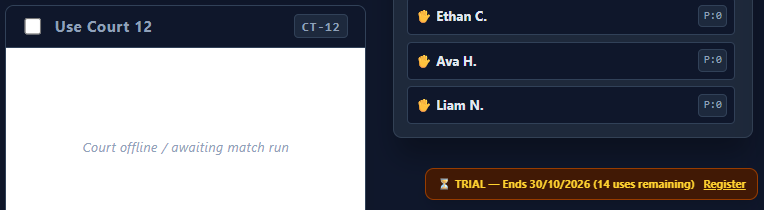
- A small badge in the bottom-right corner shows your remaining trial uses or days — it doesn't block anything on its own while the trial is still active.
- The trial ends after 15 app launches or 30 days, whichever comes first.
- Once the trial ends, a registration screen blocks further use until you register.
Registering
- 1Click Register on the trial badge (or wait for the registration screen once the trial ends).
- 2Enter the email address and license key you were provided when you purchased DM3W.
- 3Submit — the key is checked securely online, so the device needs an internet connection at this moment.
5. Managing the Player Pool
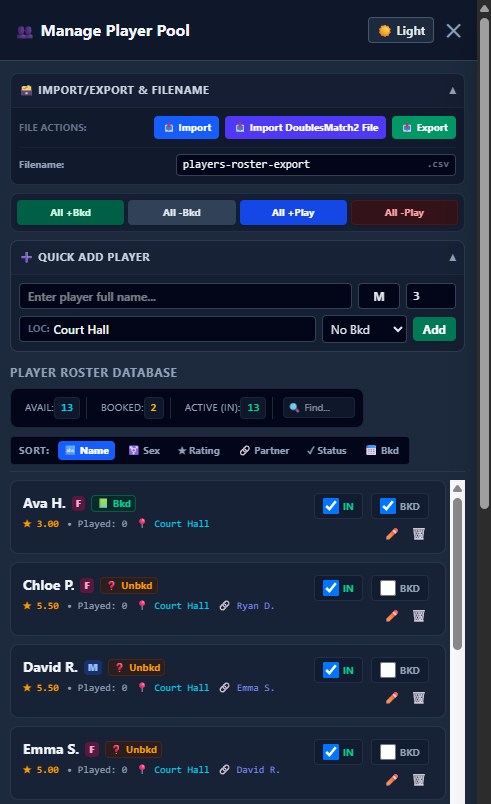
Click 👥 Manage Players in the toolbar to open the player roster drawer. This is where you add, edit, check in, and remove players, where the fixed-partner links are set up, and where you import and export your dataset as CSV files.
 📸
Adding and editing a player
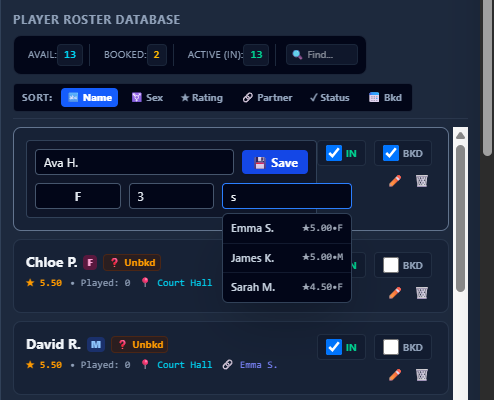
Use the inline edit row to add a new player or update an existing one. Click ✏️ Edit Profile on a player's row, make your changes, then click 💾 Save to commit them.
Names must be unique at a location. The app tells players apart by name, so it will not let you add or rename a player to match someone already at the same location — add an initial or surname instead (e.g. "Sam T" and "Sam K"). The same name at two different locations is fine. If a CSV you import contains duplicate names at one location, you are warned first and can cancel to fix the file.
| Field | What it does |
|---|---|
| Name | The player's display name. Used everywhere else in the app to identify them. |
| Sex | Used by the Gender Doubles and Mixed Doubles allocation options. |
| Rating | A numeric skill rating used by "Balance Team Ratings" and the "Skill-Tier Doubles" option (see Allocation Options). |
| Partner (Fixed Partner) | An autocomplete field for locking this player to a fixed doubles partner. See below. |
| Playing Location | Which venue/location this player belongs to. |
| In / Out (attendance) | Checkbox marking the player as checked in (present and eligible to be allocated to a court) or checked out (excluded entirely, no bench slot). Switching a player Out while they're currently seated on a court for the round in progress opens a choice rather than acting immediately — see below. |
| Bkd | A separate "booked" flag, independent of attendance, used for your own bookkeeping/tracking purposes. |
Removing an attending player who's seated on a court
Unticking In for a player who is currently placed on a court for the round in progress opens a small dialog with three choices, rather than acting straight away:
- Switch Out, but finish this round — marks them Out immediately, but leaves them on their current court seat untouched so they finish the match already under way. They simply won't be drawn into the next round.
- Remove from court now and switch Out — the original behaviour: clears their court seat straight away (opening it up for this round too) and marks them Out.
- Cancel — keep them In — makes no change at all; the player stays In and on their court exactly as they were.
A player who is checked Out while sitting on the Bench Pool (not currently on a court) switches Out immediately — there's no court seat to decide about, so this dialog doesn't appear.
Fixed Partners
Typing into the Partner field shows an autocomplete dropdown of existing players. Selecting a partner creates a reciprocal link — the other player's own Partner field is automatically updated to point back to this player. Fixed partners are only actually kept together on court when the 🔗 Use Fixed Partners allocation option is switched on (see Allocation Options).
* — so the Partner autocomplete, and the 🔗 badge on the court board, can always tell them apart.
 📸
"Needs to leave by" reminders
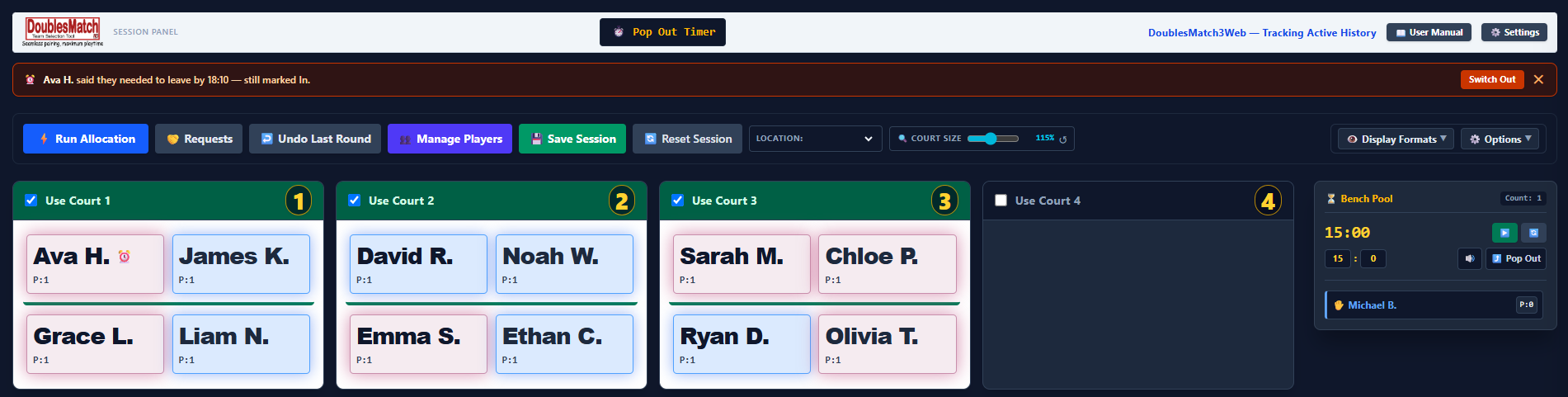
If a player tells you during a session that they need to leave at a particular time, you can set that on their row so you don't have to remember it yourself. Every player currently marked In has a small clock icon on the bottom row of their card, next to the edit and delete buttons:
- ⏰ (grey) — no departure time set. Tap it to open your device's own time picker and set one.
- ⏰ (red) — a departure time is set. Hover or long-press the icon to see the time itself; tap it to open the picker again and change it, or tap the small red ✕ beside it to clear the reminder entirely.
Setting a time doesn't do anything by itself at the moment you set it — it's the reminder (below) that actually prompts you once that time is getting close. The reminder, and the time itself, are both cleared automatically the moment that player is actually switched Out, so there's nothing to tidy up afterwards.
 📸
Where the reminder shows up
- A banner across the top of the main dashboard, naming the player and their time, with a one-click Switch Out button (which opens the same three-way choice described above if they're currently on a court) and a dismiss ✕. Dismissing the banner only hides that one notice — it doesn't clear the player's time, so it won't keep reappearing for the same reminder, but the marker below still does.
- A small ⏰ marker next to the player's name wherever they currently appear — on their court card, or in the Bench Pool list — as a quieter backup in case the banner gets missed or dismissed.
Giving yourself advance notice
By default, both of the above only appear once a player's stated time has actually arrived. Click ⚙️ Settings in the header (next to 📖 User Manual) and use the Leave-Time Reminder box to have them appear earlier instead — set how many minutes' notice you want (5 by default; 0 reverts to only reminding once the time has passed). This is a single setting that applies to every player's reminder, not something set per player. While you're within that lead time but before the actual time, the banner reads "needs to leave by [time] — about [N] min away"; once the time itself has passed, it switches to "said they needed to leave by [time]". This setting is remembered between visits.
Rest patterns 💤
Some players need to sit out particular rounds — for example every second round, or one round in three, usually for physical reasons. Rather than switching them in and out by hand, give them a rest pattern: click the 💤 button on their row (shown for players who are checked In). It appears beside the ⏰ leave-time icon and turns blue once a pattern is set.
- Repeating pattern — choose Rest [1] round in every [2] (for example 1 in 2 is every second round; 1 in 3 means they play two rounds out of three). Then choose whether the player plays or rests the next round to be generated, and the pattern runs from there. A short preview shows exactly which rounds they will rest in.
- Specific rounds — type the round numbers to rest in (for example 2, 4, 6 or 3-5). Use this when someone always wants the even or odd rounds, whenever you set it up.
A rest is strict. On a rest round the player is left out of the allocation completely, whatever the other options say. They are not treated as a bye: they earn no bench priority and never get a Double Bye warning. In the Bench Pool they show a 💤 Resting tag for the round that has just been generated, and the top of the Bench Pool lists who will be resting in the next round, so you can plan around them before you click ⚡ Run Allocation.
Bulk actions
At the top of the drawer, four buttons let you set attendance or booked status for every player currently shown (i.e. matching your active Location filter) at once:
- All +Bkd / All -Bkd — mark everyone as booked / not booked.
- All +Play / All -Play — check everyone in / out.
Managing your dataset: how Import and Export really work
Your data lives in two separate places inside the browser:
- The Player Pool — every player profile, across every location, stored together as one single dataset.
- The Round History — the log of rounds played, which only covers whichever location is currently active (it's cleared out automatically whenever you switch locations — see Getting Started & Locations).
Nothing is uploaded anywhere automatically — everything stays in this browser's local storage on this device. Exporting and importing CSV files is therefore your only way to back up your data, move it to another device or browser, or clean it up outside the app (e.g. in a spreadsheet).
The Import/Export & Filename panel
Expand the 🗃️ Import/Export & Filename panel at the top of the drawer to find the three file-action buttons and a Filename field:
- The Filename field sets the base name used for every file this drawer downloads. It's remembered between visits, and it automatically updates to match whatever file you last imported.
- Exporting here downloads only the player pool (roster) as
<filename>.csv— it does not include round history.
The record of the rounds played is kept in the Session Summary instead, which you can view, print or save from the 📊 Summary button, and which 💾 Save Session downloads together with the roster (see Session Management).
Importing players
Two import formats are supported, each with its own button:
| Button | Format |
|---|---|
| 📥 Import | DM3W's own native CSV format — the same layout produced by this app's own 📤 Export button, so it is the easiest way to reload a previously exported roster or move a dataset between devices. |
| 📥 Import DoublesMatch2 File | The legacy column layout used by the older "DoublesMatch2" spreadsheet tool (PlayingLocation, Name, Sex, Rating, Playing, YesTime, LastCourt, xPlayed, Bkd, SetPartner). The text (No Partner) in the SetPartner column is recognised as "no fixed partner." Use this button only if you're bringing across a roster originally built for DoublesMatch2. |
Both import buttons behave the same way once a file is chosen:
- 1You're asked to confirm, since this overwrites your entire current player pool and round history.
- 2The file is read and every row becomes a player. A row needs at least a name, sex, rating, and attendance value to be accepted — badly-formed rows are skipped rather than crashing the import.
- 3Fixed-partner links are automatically repaired to be reciprocal: if only one side of a pair's Locked Partner/SetPartner column was filled in, the app fills in the matching player's own link to point back, so both halves of the pair are properly linked (see The Court Board for how this link is shown on court cards).
- 4The Location dropdown switches to the first venue found in the file (alphabetically), and the page reloads with the new roster in place.
Exporting players
Click 📤 Export to download the current entire roster (every location) as a CSV file, using the columns below — a full backup of every player's name, sex, rating, attendance state, fixed partner, location and booked flag:
| CSV Column | Meaning |
|---|---|
| Player Name | The player's display name. |
| Sex | Any single character is accepted (not just M/F). |
| Rating | Numeric skill rating. |
| Is Active | 1 for checked-in, 0 for checked-out. |
| Locked Partner | The fixed partner's exact name, or blank for none. |
| Playing Location | Which venue this player belongs to. |
| BKD | Yes or No — the separate booked flag. |
Deleting a player
Click 🗑️ Delete Profile on a player's row to permanently remove them from the pool. Any player whose Partner field points at them is automatically unlinked at the same time, so no other profile is left with a dangling fixed-partner reference. This cannot be undone from within the app — export a backup first if you might need the record later.
6. The Court Board
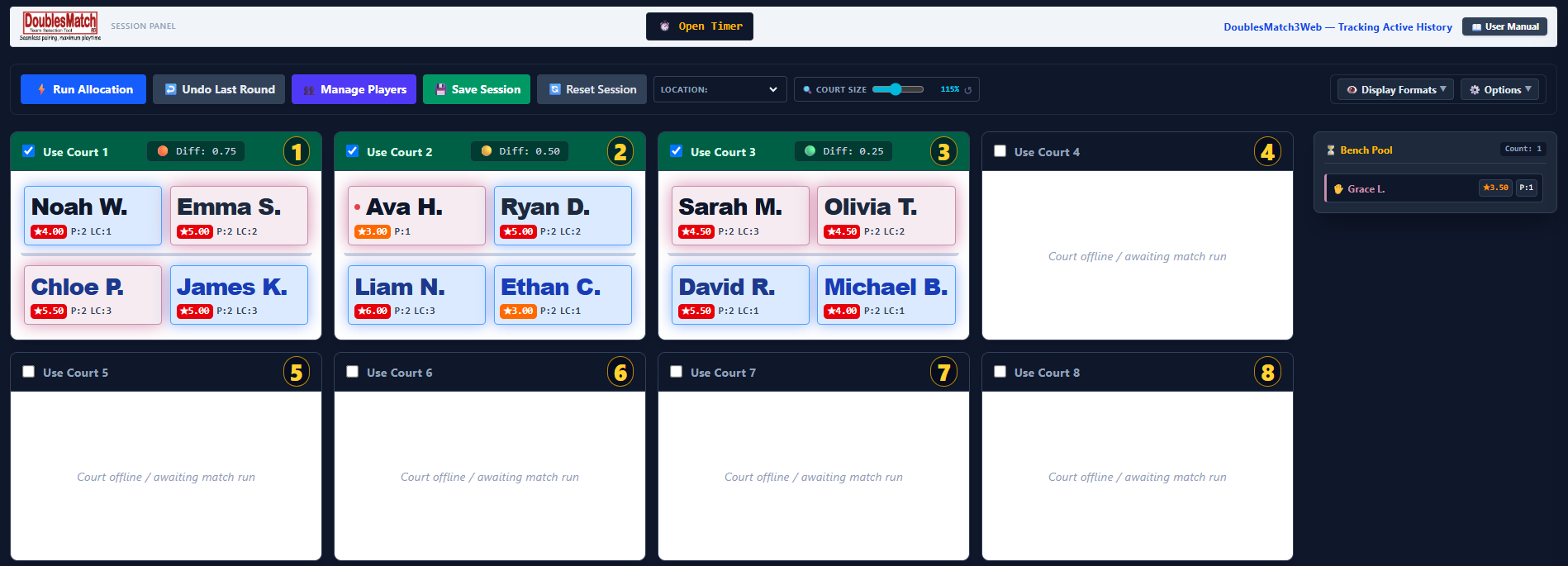
The main grid of court cards is where each round's matchups are displayed and can be adjusted by hand.
 📸
Reading a court card
| Element | Meaning |
|---|---|
| Checkbox / "Use Court N" | Whether the court is switched on and available for allocation. |
| Diff badge (📊) | Shows how balanced the two teams' combined ratings are on that court, when "Show Court Balance" is enabled. |
| ★ rating badge | Each player's skill rating, when "Show Skill Ratings" is enabled. |
| P: n badge | How many rounds that player has played so far this session, when "Show Matches Played" is enabled. |
| Last-court badge | Which court that player was on in the previous round, when "Show Last Court" is enabled. |
| ☀ beside "Use Court N" | That court is marked as a less popular court in Settings. |
| Red pulsing dot before a name | The player sat out the previous round and has just come back on from the bench. |
| ⏰ after a name | The player's "needs to leave by" time has passed while they are still marked In. Also shown on their name in the Bench Pool. See Manage Players. |
| ↻n chip (orange) | How many of the other three players on the court this player has already shared a court with this session, when "Show Repeat Court-Mates" is enabled. Solid orange if they are partnering someone they have partnered before. |
| 🔁 n badge (court header) | The number of repeat pairings on that court, when "Show Repeat Court-Mates" is enabled. |
| 🔗 badge | Appears between two players who are locked fixed partners and are playing together. |
| Coloured background/border glow on a slot | Gender Glow highlighting — tints the whole player slot (background, border and a soft shadow), not just the name, as a quick visual cue for each player's sex when enabled. The same toggle also adds a matching coloured accent to names in the Bench Pool. |
Auto-sizing active courts
DM3W automatically activates only as many courts as are needed for the number of currently checked-in players (four players per court), and any surplus players remain in the Bench Pool. As you check players in or out in the Manage Player Pool drawer, the number of active courts grows or shrinks live to match — you don't need to tick courts on or off yourself in the ordinary course of a session.
Drag and drop
You can manually adjust who's playing where:
- Drag a player from one court slot to another to swap them.
- Drag a bench player onto an empty (or occupied) court slot to bring them into play.
- Drag a player from a court back onto the Bench Pool sidebar to take them out of the round.
Manual changes are reflected immediately and are taken into account the next time you run an allocation or view the history matrix.
Substituting a leaver 🔁
When someone has to leave mid-round, the Substitute helper picks a replacement from the bench. Open it in any of these ways:
- the Substitute button on a "needs to leave" reminder;
- ☰ More › 🔁 Substitute… on a phone, or ⚙️ Settings › 🔁 Substitute a player…, then tap who is leaving from the list of players on courts;
- on a computer, right-clicking the player's name on the court. (On a phone a long press picks the player up for drag and drop, so use the menu instead.)
The helper then works as follows.
- The bench is listed best match first: players with the fewest games come first, then the closest rating. Anyone resting this round is left out. Players due to leave soon, or a different gender or level where Mixed, Gender or Skill-Tier mode is on, are listed later and tagged. Keep Apart pairs are quietly listed last, with no label.
- Nothing moves until you click a name. It works exactly like dragging that player onto the spot, including the Keep Apart confirmation.
- Tick Also switch … Out if they are leaving for the day. It is ticked for you when you start from a reminder.
- If the bench is empty, the dialog says so, and you can switch the player Out and leave the spot open.
Bench Pool
The sidebar on the right lists every checked-in player who isn't currently placed on a court. A player's name flashes red with a ⚠️ Double Bye label if they have missed two rounds in a row, so you can spot and fix an unfair bench streak at a glance. A player who sat the round out because of their own rest pattern shows 💤 Resting instead, and the next round's resters are listed at the top of the panel. Double-click any bench player's name to open the "Played With" panel for them.
7. Display Formats
Click 👁️ Display Formats in the toolbar to control what's shown on each court card and in the Bench Pool, and to turn on the hover matchup preview.
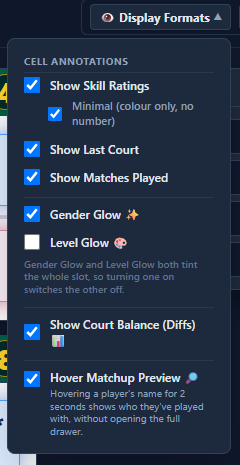 📸
| Option | Effect |
|---|---|
| Show Skill Ratings | Displays each player's ★ rating badge on court cards and the bench, coloured by their skill level. A Minimal (colour only, no number) sub-option appears underneath once this is ticked — see below. |
| Show Last Court | Displays which court each player was on in the previous round. |
| Show Matches Played | Displays each player's running "P: n" games-played count. |
| Show Repeat Court-Mates 🔁 | Off by default. Marks repeats on the court cards: a small orange ↻2 chip on the bottom row of a player's slot shows how many of the other three players on that court they have already shared a court with this session (hover it to see who, and how many times). The chip turns solid orange if they are partnering someone they have partnered before. The court's header strip also shows a 🔁 count of repeat pairings on that court. Nothing appears for courts with no repeats, and it updates as you drag players around. |
| Gender Glow ✨ | Tints each player's court slot (background, border and shadow) based on sex, for quick visual scanning, and adds a matching coloured accent to names in the Bench Pool. |
| Level Glow 🎨 | The same whole-slot tint as Gender Glow, but by each player's own skill level colour instead of their sex — see below. |
| Court Divider | A Hidden / Normal / Bold selector for the line between the two team rows on each court card — see below. |
| Show Court Balance (Diffs) 📊 | Shows a rating-difference badge on each court, indicating how evenly matched the two teams are. |
| Hover Matchup Preview 🔎 | Hovering a player's name — on a court card or in the Bench Pool — for about 2 seconds pops up a small tooltip listing who they've already played with, without opening the full Played With panel. On by default; untick here to turn it off. |
Minimal Rating Badge
With Show Skill Ratings ticked, a smaller Minimal (colour only, no number) checkbox appears indented beneath it. Turning this on replaces the "★2.54" text badge with a plain small square in that player's skill-level colour — a subtler cue for a quick glance across the board without the clutter of printed numbers everywhere. The exact rating is still available: hover over the swatch to see it in a tooltip, the same way it's always printed when this option is off.
Level Glow 🎨
Level Glow tints each player's entire court-card slot — and, more subtly, their row in the Bench Pool — using their own skill level's colour (the same colour configured in Edit Skill Levels), rather than printing a separate badge. It's the same idea as Gender Glow, just driven by skill level instead of sex, and is meant for a quick at-a-glance read of who's in which level across a whole board of courts.
Court Divider
Each court card shows two team rows, and by default a line separates them — a visual "net." The Court Divider selector controls that line:
- Hidden — no line at all. Useful when you're placing 4 players on a court and telling them to sort out partners themselves, since a visible team split isn't meaningful there.
- Normal — today's existing look (the default; nothing changes until you switch this).
- Bold — a thicker, darker line, for sessions where which two players are actually paired together matters and should stand out.
8. Allocation Options
Click ⚙️ Options in the toolbar to control how the automatic allocation engine builds each round's matchups. These settings apply the next time you click ⚡ Run Allocation.
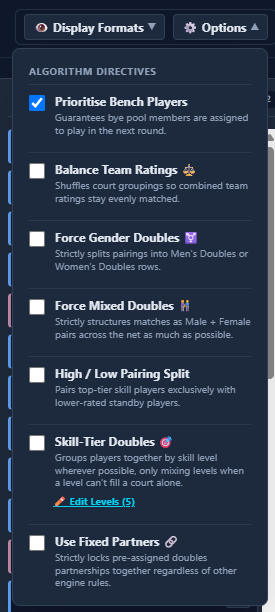 📸
| Option | Description |
|---|---|
| Prioritise Bench Players | Guarantees bye pool members are assigned to play in the next round. |
| Avoid Repeat Court-Mates 🔀 | On by default. Mixes courts and teams so players meet as many different people as possible across the whole session (see below). Remembered on this device. |
| Balance Team Ratings ⚖️ | Builds courts and teams so both sides have close combined ratings: stronger players are matched with weaker partners (a 4.5 with a 2.x or 3.x, for example), rather than leaving it to chance who lands on the same court. It works alongside every mode — Gender and Mixed Doubles balance within their own rules, and Skill-Tier courts, which are already close in level, balance the teams within each court. It weighs evenness against "Avoid Repeat Court-Mates", so when both are on you get close teams and fresh court-mates wherever the two can both be had. Players with no rating are treated as 3.0. |
| Force Gender Doubles ⚧ | Strictly splits pairings into Men's Doubles or Women's Doubles rows. |
| Force Mixed Doubles 👫 | Strictly structures matches as Male + Female pairs across the net as much as possible. |
| Skill-Tier Doubles 🎯 | Groups players together by rating wherever possible, only mixing levels when a tier can't fill a court on its own. Tiers are your own editable skill levels (see below), not a fixed set of bands. Mixing a thin tier with its nearest neighbour is expected whenever that tier's headcount this round isn't an exact multiple of four — the few players left over are matched with whichever tier is closest rather than sitting out. Before finalising, the engine tidies up any court with three players from one level and one stray from another by swapping the stray with a benched player of the right level who has played the same number of games or fewer (never someone who sat out last round). |
| Use Fixed Partners 🔗 | Strictly locks pre-assigned doubles partnerships together regardless of other engine rules. |
Example: 51 players with 6 Beginners, 25 Novices and 20 Intermediates, on 12 courts. Single-level courts could in principle fill all 12 (1 + 6 + 5), leaving 3 players over. Instead the app makes 11 single-level courts and one mixed court, so one Intermediate court is replaced by the mixed group. Either way, 3 players sit out. What changes is which 3 they are and whether one court is mixed.
The number of courts held back is the number of leftover players divided by four, rounded up (so 1 to 3 leftovers hold back one court, 5 to 8 hold back two, and so on). Where every level's headcount is an exact multiple of four, nothing is left over and every court is single-level.
Editing Skill Levels
Next to the Skill-Tier Doubles checkbox is an ✏️ Edit Levels link showing how many levels are currently defined. Click it to open the level editor.
Each level is a row with four parts: a colour swatch (used for that level's rating-badge colour throughout the app), a name you can type freely, a floor rating (the lowest rating, inclusive, that belongs to this level), and a live count of how many of this session's currently-active players (within the current location filter, if one is set) fall into that level right now. Levels must be entered lowest floor to highest, starting at 0 — the app runs each player's rating down the list and places them in the highest level whose floor they meet or exceed. The count updates as you type, so you can see straight away whether a floor change has emptied one level into its neighbour or split a crowded one apart.
Use ➕ Add Level to insert another row (up to 8 levels total), or the 🗑️ icon to remove one (down to a minimum of 2). Reset to Default restores the app's built-in five-level starting point (Beginner / Novice / Intermediate / Advanced / Pro at 0 / 2 / 3 / 4 / 5). Changes only take effect once you click Save — closing with Cancel or ✕ discards them. Your levels are saved on this device and are used both by Skill-Tier Doubles allocation and by the colour of every player's rating badge elsewhere in the app.
Courts for each level 🎯
With Skill-Tier Doubles on, each level in ✏️ Edit Levels can have its own courts, so (for example) Novice always plays on courts 1–3 and Advanced on 4–6. Type them in the Courts box under the level's name, like 1-3 or 1-3, 10. Leave the box empty for "any court".
- Suggest courts fills the boxes for you: one court for every four players currently checked in at each level (a leftover of two or three gets a court too), lowest level on court 1 and upwards, within your court limit. Change any of the numbers afterwards. The "needs ~N" figure beside each box is the same sum, live.
- Use these courts when allocating is a switch at the top of the dialog. Untick it and the app allocates exactly as it did before, while keeping the courts you typed for next time.
- It is a preference, not a hard limit. A level's groups use its own courts first. If a level has more groups than courts, or a court isn't needed by its level, the extra groups use courts nobody has claimed, then courts set for another level that weren't needed. When that happens a blue note appears under the header after the round is generated, saying what was used where. Dismiss it with ✕.
- Two levels can't be given the same court; Edit Levels will tell you when you save.
- Showing the level. Tick 👁️ Display Formats › Show level on courts to put a small level name on each court's header, based on who is actually playing there ("Mixed" where Skill-Tier Doubles had to combine levels). The Session Summary also lists the courts set aside for each level.
Keep Apart 🚫
The Keep Apart list is a permanent list of player pairs who should not be put on the same court. Open it from ⚙️ Settings › 🚫 Keep-apart list…, or from ☰ More on a phone. Pick two players from the roster (names autocomplete), add an optional private note, and click Add. Use Remove to delete a pair.
- It's a strong preference, not an absolute rule. The allocator avoids putting a listed pair on one court wherever it can. If a round truly can't be built without it (for example with very few players and a long list), the pair is placed together and you get a short message saying so.
- "Together" means the same court — they can still be on neighbouring courts, or one can be on the bench.
- Not as partners. When adding a pair you can choose Same court is fine, but not as partners instead. Those two may share a court (as opponents) but the allocator won't put them on the same team. Click the Apart / Not partners tag on a listed pair to switch it. It is treated the same way as the other kind: a strong preference, overridden by Court Requests, checked on drag and drop, and reported only if it can't be avoided (for example when Fixed Partners forces the two together).
- Court Requests override the list. If you deliberately request a court that seats two listed players together, that is respected. Open spots in a requested court are filled with players who don't clash where possible.
- Drag and drop is checked too. If a manual move would put a listed pair together, you are asked to confirm first.
- Matched by name. Renaming a player in Manage Players updates the list automatically.
- It is kept between sessions. Reset, Save Session, importing a roster and changing location do not clear it. It lives in this browser, so use 📥 Export list now and then as a backup, and 📤 Import list to load it on another device.
9. Generating a Round
- 1Make sure everyone present is checked in via the Manage Player Pool drawer.
- 2Set your allocation options as described above.
- 3Click ⚡ Run Allocation.
The engine fills every active court, updates each player's games-played and last-court figures, and logs the round into the Round Log History and History Matrix sections below. Anyone left over becomes the new Bench Pool for that round.
Avoid Repeat Court-Mates
With this option on (the default), each new round is checked against every earlier round of the session, not just the last one. After the engine decides who plays, it rearranges courts and teams so that players share a court — and especially a team — with someone new wherever it can. It works within whichever mode you have chosen: Gender Doubles keeps courts single-sex, Mixed Doubles keeps two men and two women, Skill-Tier Doubles keeps each court's skill mix, and Fixed Partners stay together.
Fairness is protected. The engine will only swap a seated player for a benched one if the benched player has played the same number of rounds or fewer, and never if the seated player sat out the previous round, so nobody gets two byes in a row.
Repeats can't always be avoided. Each round a player meets three others, so a small group, a long session, or a restrictive mode (such as Gender or Skill-Tier with few players in a group) will eventually run out of new faces. In that case the engine keeps repeats to a minimum and spreads them evenly. Switch the option off and courts and teams are no longer rearranged to avoid repeats.
Court Requests 🤝
When players ask to play together (or against each other), click 🤝 Requests next to ⚡ Run Allocation instead of moving people around afterwards. Choose up to four players from the checked-in list — Team 1 in the first two boxes and Team 2 in the last two — and leave any box on anyone to have the engine fill that seat. For example:
- Two players who want to partner: put them in the two Team 1 boxes.
- Two players who want to play against each other: one in a Team 1 box, one in a Team 2 box.
- Three named players: name them and leave one seat on anyone; the engine picks the fourth by the usual rules.
- Just the same court: tick Just the same court — choose the teams automatically if the teams don't matter.
Then choose how long it lasts: the next round only, the next 2 to 5 rounds, until you clear it, or specific rounds — type round numbers such as 3, 5 or 4-6 (as counted in the Round Log) and the request waits quietly until each of those rounds comes up, then drops off after the last one. Each request shows in the Queued list, where the ✕ removes it at any time; a counter on the button shows how many are waiting. When you click Run Allocation, each request is seated on a court of its own first, and the rest of the board is built around it using whichever options you have on. A request that runs for several rounds uses up one round each time it is seated and drops off when it is finished.
You can run allocations again at any time to generate the next round — the engine automatically takes bench history into account (especially with "Prioritise Bench Players" enabled) so the same players aren't left out repeatedly.
Undoing a round
Click ↩️ Undo Last Round next to ⚡ Run Allocation to reverse the most recently generated round: every involved player's games-played count and last-court badge is rolled back, and the court board is restored to how it looked before that round ran.
10. "Played With" Panel
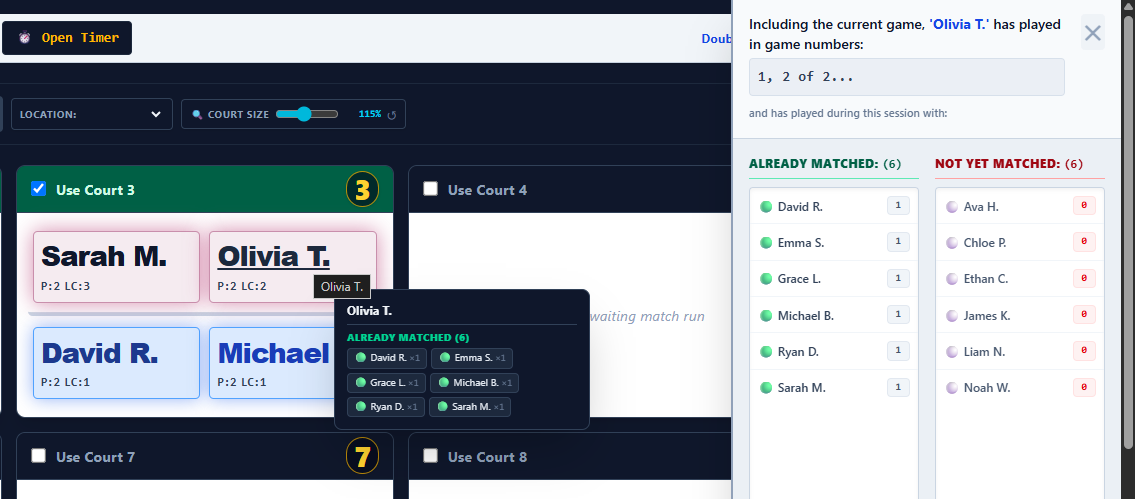
Double-click any player's name — on a court card or in the Bench Pool — to open the Played With panel. It shows:
- Which round numbers that player has appeared in so far this session.
- An Already Matched column — every other checked-in player they've shared a court with, and how many times. Anyone they've shared a court with more than once is highlighted in amber (🟠) so repeats stand out at a glance.
- A Not Yet Matched column — everyone they haven't played with yet.
This is useful for manually steering variety, or for spotting when two players have (or haven't) played together enough over the course of a session.
 📸
11. Round History Matrix
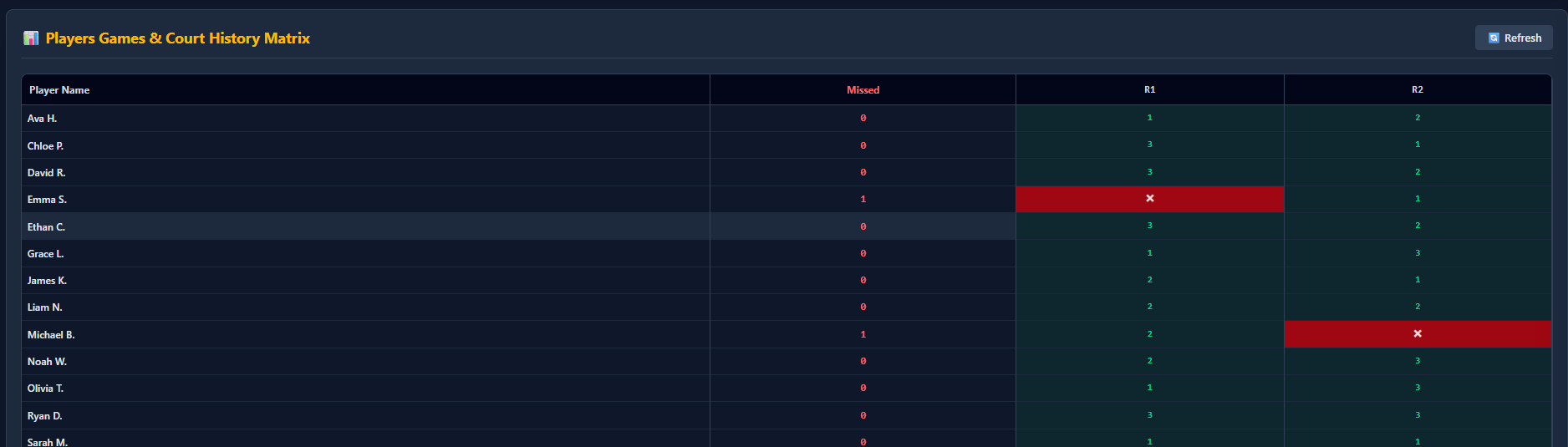
The 📊 Players Games & Court History Matrix section at the bottom of the page shows a full grid: one row per checked-in player, one column per round played, with the court number they were on (or a red ✖ if they missed that round), plus a running Missed count per player.
Click 🔄 Refresh to reload the matrix — useful after you make manual drag-and-drop changes, since the matrix does not always update itself live.
 📸
12. Round Log History
The 📜 Chronological Round Log History section lists every round generated this session, with the exact matchups per court. Click 📊 Summary to open the Session Summary, which includes every round's courts and teams and can be printed or saved.
The Manage Player Pool drawer only exports the player pool (roster), not the rounds (see Managing the Player Pool). The rounds are saved in the Session Summary file whenever you use 💾 Save Session, or choose to download the summary before a reset or before switching locations (see Session Summary).
13. Session Summary 📊
The Session Summary shows how the session went. It is worked out from the rounds already stored, so there is nothing to set up. Open it any time after the first round with 📊 Summary (beside Save Session, and in the Round Log History section), including part-way through a session for a quick fairness check.
What it shows
- Headline figures — the range of games played, the average number of different people each player met, how many pairs met more than once, how many players had two games in a row on a less popular ☀ court, how many players sat out two rounds running (double byes), and how many rest rounds were taken.
- How fair was the session? — the same points in plain sentences. Rest rounds are explained so a lower game count by request isn't mistaken for unfairness.
- Every player, round by round — each player's court in every round (☀ marked courts highlighted, 💤 rests, – benches), then games played, how many different people they met, how many people they met more than once, and games on marked courts. Click any heading to sort. A fixed partner is never counted as a repeat.
- Set Partners — for each pair with a Set Partner in the roster: how many games they played on the same team (Together), how many rounds both were playing but on different teams (Split), and how many rounds only one of them played because the other rested, was benched or wasn't there (One out). The read-out above it also says whether every set pair played together whenever both were playing. The section only appears when the session has set pairs.
- Games on each court and Round details — every round's time, court and teams, with who rested or was on the bench. Round details starts collapsed.
Printing and saving
- 🖨️ Print opens the browser's print dialog with a clean black-and-white page (choose Save as PDF there if you prefer a file).
- 📋 Copy as text copies a plain-text version to paste into a message.
- 💾 Save .txt and 📥 Save .csv download the full summary, including all the round details, as a text file or a spreadsheet.
When it is saved automatically
💾 Save Session downloads the roster and the summary (text). 🔄 Reset Session and changing location both offer to download the summary first, because resetting clears the rounds. The summary itself is not stored in the app: if you want to keep it, save it.
14. Countdown Timer
The round timer lives inline at the top of the Bench Pool sidebar by default, pinned just under the ⏳ Bench Pool header so it stays visible no matter how long the bench list gets.
- Edit the minutes/seconds fields directly to set a custom duration (defaults to 15 minutes). These fields are locked while the timer is actively running or paused mid-count.
- Click ▶️ to start the countdown; it becomes ⏸️ while running.
- Click 🔄 to reset to the last duration you set.
- Click 🔊 to open the alarm sound setting. When the timer reaches zero, an alarm sound plays; click 📂 Browse... to upload your own
.wavfile instead of the default beep, or the 🗑️ button to remove a custom sound and revert to the default. The sound is changed here, on the main screen only (bring a popped-out timer back first). A popped-out timer uses the same saved sound.
Popping the timer out
Click ⤴ Pop Out on the inline timer to move the live countdown into its own separate window — handy for dragging onto a second monitor the players can see. The countdown itself isn't restarted or reset by popping out: it keeps ticking from wherever it was.
While the timer is popped out, the Bench Pool shows a small "Timer running in a separate window" panel in its place, with two buttons:
- Focus Window brings the already-open timer window to the front without touching the countdown.
- ⤵ Bring Back hands the live countdown back to the inline widget on the dashboard and closes the separate window — the countdown carries over exactly as it was, with no reset and no lost time.
At any moment, only one of the two — the inline widget or the popped-out window — is actually ticking and able to play the alarm, so there's never a risk of two countdowns (or two alarms) running out of sync with each other.
15. Session Management
On a phone or other narrow screen, the buttons that don't fit are tucked behind ☰ More beside Manage Players: Requests, Pop Out Timer (Focus Timer while it's popped out), Summary, Save Session, Reset Session, the Location selector and the Court Size slider. A small amber dot on the button shows that court requests are queued. On a laptop or larger screen every button is shown in the toolbar as usual.
| Button | What it does |
|---|---|
| 💾 Save Session | Confirms with you, then downloads the current (all-location) roster as a CSV file and the Session Summary as a text file in one step — the recommended way to end a session cleanly. |
| 🔄 Reset Session | Confirms with you, then clears every player's games-played and last-court figures, any rest patterns and queued court requests, and wipes the round history. If any rounds have been played it first offers to download the Session Summary, since the rounds can't be recovered afterwards. Use this to start a completely fresh session with the same roster. This affects the whole player pool (every location), not just the currently-selected one. |
16. Tips & Troubleshooting
- A player's fixed partner didn't update, or the 🔗 badge isn't showing? Open Manage Player Pool and re-save the Partner field on either player — this forces the reciprocal link to be written on both records. Player names must be unique at a location (see Managing the Player Pool), so if the app refused a name, add an initial or surname to tell them apart.
- A new feature or fix isn't showing? Reload the page (F5 or Ctrl+R on a PC, or close and reopen the app on a phone) — updates only take effect on reload. See Installing as an App.
- Can't find "All Locations" in the Location dropdown anymore? That option has been removed on purpose (see Getting Started & Locations) — pick the specific venue you want to work with instead.
- Courts aren't turning on as I check players in? Auto-sizing only activates courts up to the number needed for the currently checked-in count at four players per court; if you need more courts active than the current headcount justifies, tick them on manually.
- The history matrix looks out of date after a manual drag-and-drop change? Click the 🔄 Refresh button in that section.
- Switching locations wiped my round history? This is expected — each location keeps its own independent round history. Accept the backup prompt before switching if you want to keep a copy: it downloads the roster and the Session Summary.
- Importing a file wiped out players from a different venue? Also expected — Import always replaces the entire player pool across every location, not just the current one (see Managing the Player Pool). Always export a full backup first.
- Importing a DoublesMatch2 file didn't bring across partners correctly? Make sure the SetPartner column uses
(No Partner)exactly for players without a fixed partner, and that partner names match another row's Name column exactly (including spelling and capitalisation). - Losing data between sessions? DM3W stores everything locally in your browser. Using a different browser, device, or a private/incognito window will not show your existing data. Export regularly, especially with 💾 Save Session.
- No Install App button? It only appears on Chrome/Edge desktop or Chrome on Android, and only before the app is already installed. On an iPhone or iPad, use Safari's own Share → Add to Home Screen instead (see Installing as an App).
- Registration won't go through? Double-check the email and license key are typed exactly as provided, and make sure the device is online — the key is verified securely over the internet (see Trial & Registration).